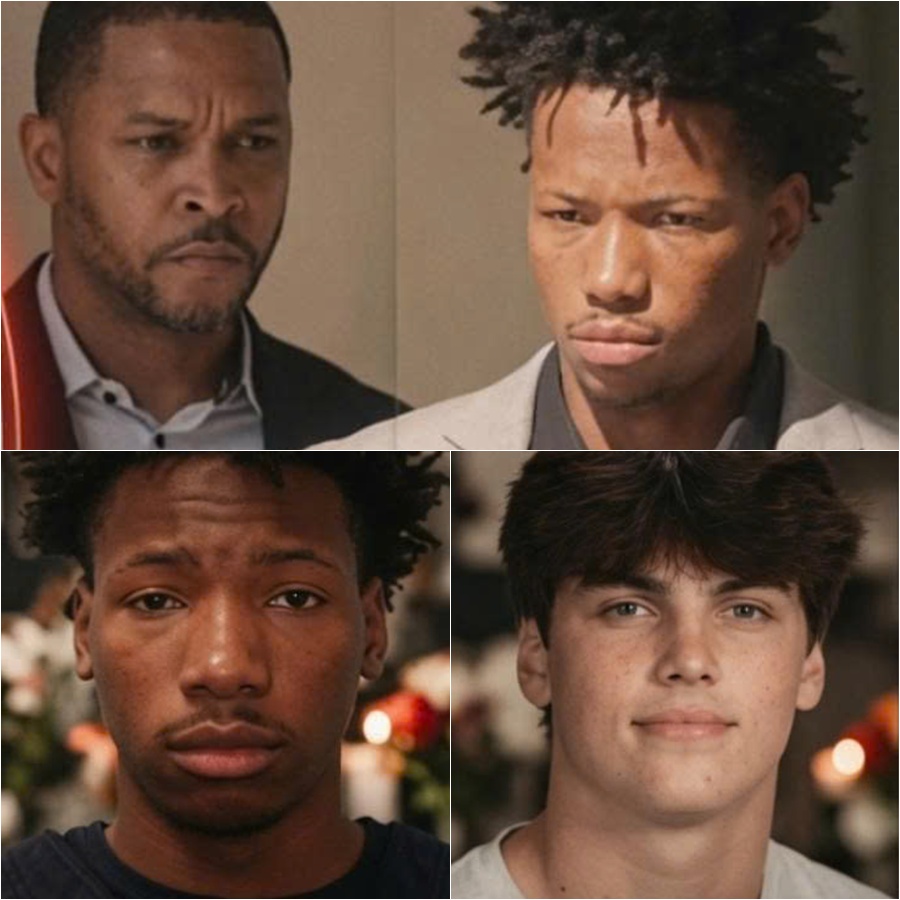
Frisco, Texas — When the doors of the Collin County Jail officially slammed shut behind 19-year-old Karmelo Anthony on Tuesday evening, June 9, 2026, one of the most tense and polarizing legal chapters in the county’s history came to a close. The devastating 35-year prison sentence for first-degree murder handed down to the teenager marked a grim conclusion to a grueling 14-month legal saga following the slaying of high school football MVP Austin Metcalf.
Yet, for the victim’s family and the residents of Frisco, relief did not come easily. While the courtroom floor became a theater of tears and high-stakes family impacts, the absolute darkest chapter of the entire ordeal didn’t unfold during the public trial. It happened during the preceding 14 months, right on the streets of the affluent suburban city of Frisco. It was a period where a killer was allowed to sleep in the comfort of his own bed, fueled by a highly scrutinized judicial decree: the decision to slash his initial bail from $1 million to $250,000.
This decision did not just push a grieving family to the brink of profound psychological trauma; it turned Frisco into a political and social tinderbox, inciting the mobilization of right-wing militias and raising terrifying questions about the true price of pre-trial justice in America.
From $1 Million to Under House Arrest: The Slashing of the Bail
The controversy dates back to the immediate aftermath of April 2, 2025. Under a rainy dispute at David Kuykendall Stadium, a petty argument under a sports tent rapidly escalated into horrific violence. Anthony, then a high school senior, pulled out a semi-serrated pocket knife and plunged it directly into the chest of 17-year-old Austin Metcalf on the stadium bleachers. The single lethal blow through the heart instantly snuffed out the life of the beloved Frisco Independent School District (Frisco ISD) football captain.
Following the attack, Anthony surrendered to the Frisco Police Department. Recognizing the extreme bạo lực of the act and the public panic it induced within the school community, a magistrate originally set Anthony’s bail at a towering $1 million.
To the public, the seven-figure sum felt entirely appropriate for a localized tragedy that left an outstanding young man dead. But behind the closed doors of the justice system, a ferocious legal battle was brewing.
Representing Anthony was Mike Howard, a high-profile criminal defense attorney in Texas. Howard quickly filed an emergency motion for bond reduction, arguing that the $1 million figure was “unconstitutionally excessive.” The defense pointed to Anthony’s pristine record: he was a Centennial High School student, an elected track team captain, and a teenager with absolutely no prior juvenile or adult criminal history.
The defense maintained that Anthony presented zero flight risk and, crucially, that his initial statements to police—crying hysterically and stating “I was protecting myself”—pointed to a defensible claim of self-defense rather than a cold-blooded public threat.
Over the fierce objections of Collin County prosecutors, the court relented. The judge slashed the bond to $250,000, allowing Anthony to secure his release by posting a 10% corporate surety (equivalent to $25,000). The conditions, however, were strict:
-
Full house arrest.
-
No internet access.
-
GPS ankle monitoring.
-
A total ban on entering Frisco city limits or contacting any Frisco ISD students.
Yet, to the Metcalf family, those strict conditions were nothing more than a formal consolation.
“A Lifetime Sentence vs. A Luxury Stay”: 14 Months of Silence and Torment
The moment Karmelo Anthony walked out of the Collin County Jail in the spring of 2025, a new wave of profound trauma washed over the Metcalf family. While they were planning a funeral and attempting to piece together their shattered lives, the accused killer was enjoying the comforts of a suburban home.
The agony of the Metcalf family was severely aggravated by a strict judicial gag order. For 14 months, while local activist networks and national right-wing provocateurs used the $250,000 bond decision to fight a proxy culture war online, Austin’s parents were legally barred from publicly speaking out to defend their son’s memory or expressing their disgust with the bail system.
The depth of that dồn nén suffering was finally laid bare on Tuesday night during the trial’s emotional sentencing phase. Jeff Metcalf, Austin’s father, took the stand. His eyes locked on Anthony, his voice booming through the courtroom:
“With a gag order, I couldn’t defend myself when people wanted to tear down my son’s memory. That time is over,” Jeff Metcalf said loudly. “I said from day one this was never about race. It’s about right and wrong. We all bleed the same color. You allowed a kid who took a life to sit at home while we had to pass an empty bedroom every single night.”
Megan Metcalf, Austin’s mother, echoed the sentiment, bitterly contrasting Anthony’s temporary pre-trial restriction with the eternal finality of her son’s absence:
“You may have been given a sentence of 35 years today, and you got to spend a year at home before this. You should feel lucky,” she wept. “I’ve been sentenced to a lifetime without my son. I only have videos and memories of his laugh.”
Frisco Becomes a Tinderbox: The Politicization of Pre-Trial Justice
The bond decision didn’t just devastate the Metcalfs; it turned the city of Frisco into a battlefield of extreme viewpoints. On platforms like X (formerly Twitter) and Reddit, the narrative rapidly polarized along racial lines, especially as the element of race was pushed to the forefront: Anthony is Black, and Metcalf was White.
Conservative commentators and right-wing internet personalities seized on the bail reduction as proof of a “weak-on-crime” judiciary operating under ideological pressure. The situation escalated to a dangerous extreme when Jake Lang, a high-profile right-wing provocateur, publicly called for Anthony to be “lynched” following his release on bond. The threat was deemed so credible that local police intelligence units had to monitor far-right forums to prevent vigilante violence.
Conversely, left-leaning advocacy groups and the Next Generation Action Network (NGAN)—which worked closely with Anthony’s mother, Kayla Hayes—claimed that the backlash to the bond was entirely manufactured by white supremacists fixated on the case. NGAN released a public statement revealing that following Anthony’s release on the $250,000 bond, the Anthony family home faced an “alarming increase in death threats, continued harassment, and physical intimidation,” forcing the family to implement private security measures just to survive the pre-trial phase.
The Collapse of the Self-Defense Claim Before Real Justice
However, the 14 months of freedom bought by the $250,000 bond did nothing to save Karmelo Anthony from a harsh judicial reckoning. Throughout the eight-day trial, Collin County District Attorney Bill Wirskye masterfully weaponized the facts of the crime to render the pre-trial bond completely irrelevant.
The prosecution called a total of 21 witnesses, including student teammates who watched the confrontation unfold. Witnesses testified that Anthony was the undisputed aggressor, provoking Metcalf by holding his hand inside his backpack (where the knife was hidden) and warning him: “Touch me and find out.”
The defense’s portrayal of Anthony as a passive, frightened child who deserved the leniency of home confinement evaporated under the forensic reality: a single, lethal blow through the victim’s heart delivered with immense force.
When the 12-person jury took less than three hours to reject both a lesser manslaughter charge and the “sudden passion” mitigation clause, it was a definitive statement from the legal system: pre-trial luxury would not dictate or diminish post-trial justice.
Conclusion: An Ending with No Winners
Outside the Collin County courthouse following the 35-year verdict, there was no celebration—only an overwhelming sense of exhaustion and bitterness. Trey Snider, a local small-business owner who had attended rallies surrounding the trial, summarized the community’s sentiment:
“Had he walked free after being out on bond for a year, I would have said there’s no justice left in Texas. But I’m not rejoicing in that kid going to jail for most of his life either. There’s nothing to celebrate here. The bond just stretched out a nightmare that should have been settled a long time ago.”
The case of Karmelo Anthony and Austin Metcalf will remain in Texas legal annals not only as the tragedy of high school violence but as a painful lesson on how the pre-trial bail system can inadvertently deepen a victim’s grief and plunge a community into deep division.