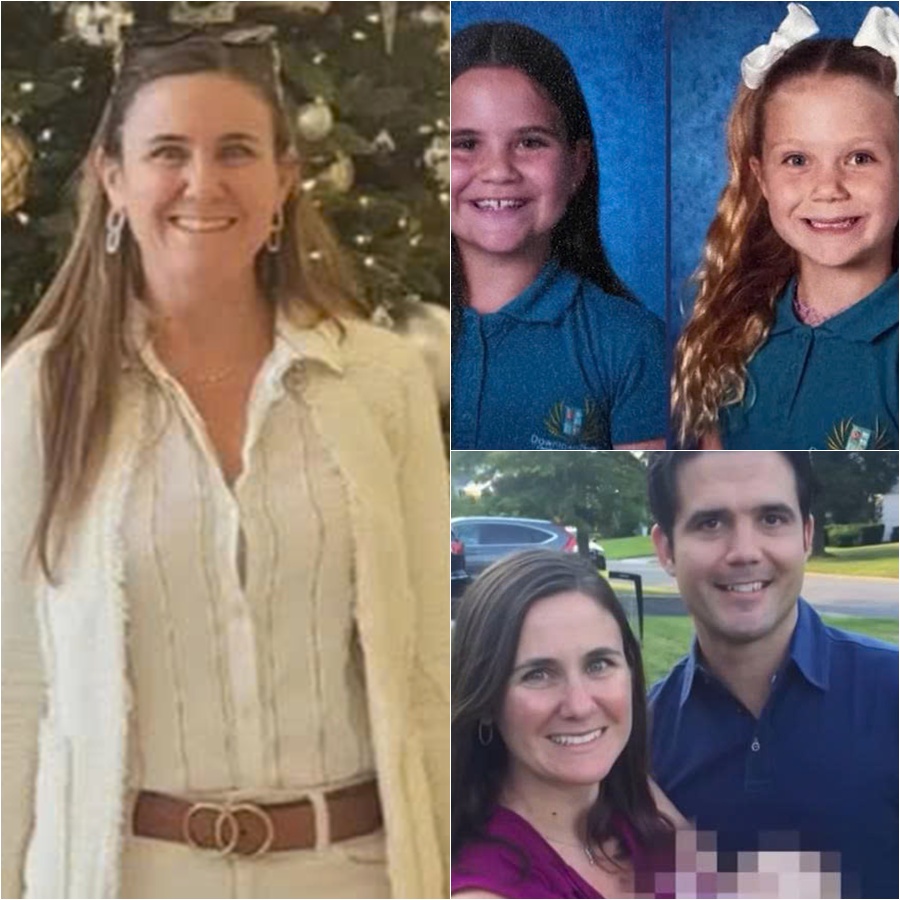
A luxurious suburban Miami home, radiant photos on social media, and a highly successful career envied by many… All of it was brutally extinguished on a horrific June night. The murder-suicide that claimed the lives of prominent real estate professional Melanie Hyer, her two young daughters, and their father has not only sent shockwaves through the community of Doral, Florida, but also exposed the suffocating, hidden turmoil of domestic conflict masked by a flawless public image.
Part 1: A Horrific Night in an Upscale Neighborhood
Doral Isles has long been known as one of the most peaceful, affluent, and well-manicured residential communities in Doral, South Florida. The meticulously landscaped lawns, swaying palm trees, and tight security make it a haven synonymous with prosperity. However, on a fateful Tuesday night in June 2026, that tranquility was violently shattered.
Responding to a welfare check requested by worried family members and friends who had lost contact with the family, emergency responders and homicide detectives from the Miami-Dade Sheriff’s Office arrived at the upscale residence. When the door opened, they stepped into a scene of unimaginable horror—one that would haunt even the most veteran investigators.
Inside the home lay four lifeless bodies in pools of blood. The victims were quickly identified as:
-
Melanie Hyer (46), a prominent real estate agent.
-
Savannah (11), Melanie’s eldest daughter.
-
Sienna (8), Melanie’s youngest daughter.
-
Ryan Charles Whiten (42), the girls’ father and Melanie’s estranged partner.
According to preliminary investigation results, all four individuals died from multiple deep stab wounds. The crime scene analysis and evidence led the Miami-Dade Sheriff’s Office Homicide Bureau to focus on a murder-suicide as the leading theory. Ryan Charles Whiten is believed to have brutally attacked his estranged partner and two biological daughters before taking his own life with the same weapon.
The choice of a knife—a weapon requiring close physical proximity and an immediate outburst of violent energy—indicates a state of absolute frenzy, loss of control, or an intense rage that had been simmering inside the perpetrator for a very long time.
Part 2: Portrait of a Dedicated Mother and Two “Angels” Cut Short
The sudden deaths of Melanie Hyer and her two daughters came as a massive shock to the local business community and neighborhood residents. Relocating from Manhasset, New York to South Florida, Melanie had quickly established herself as a powerhouse in the high-end real estate market. She was a highly accomplished expert specializing in probate real estate, frequently handling high-value commercial properties and luxury waterfront estates.
Beyond being a sharp businesswoman who regularly appeared as an industry expert on local news outlets, Melanie was known as a resilient single mother. Her social media profiles were filled with vibrant photos of her and her daughters: sun-drenched vacations, warm birthday celebrations, and Melanie’s beaming smile alongside her girls at school events. Colleagues respected her for her professionalism, dedication, and incredible ability to balance a demanding career with motherhood.
“Melanie was a light of sunshine. She was always energetic, knowledgeable, and deeply dedicated to her daughters’ well-being. Anytime the school needed a volunteer, she was the first to sign up,” shared Doral Mayor Christi Fraga—a personal friend of Melanie—in an emotional Instagram post.
The two daughters, Savannah (11) and Sienna (8), were students at Downtown Doral Elementary School. In the eyes of their teachers and peers, the sisters were well-mannered, talented children who brought positive energy to the classroom. One loved to draw, while the other was passionate about sports and dance. The future of these two innocent souls should have been bright and full of potential, had it not been violently cut short by the hands of their own father.
Part 3: The Undercurrents Behind the “Co-Parenting” Mask
As the glamour of public success was stripped away, investigators began uncovering the fragments of a toxic, years-long relationship between Melanie and Ryan. Although they were estranged and living separately, they had to maintain contact to fulfill their co-parenting duties. However, the inability to heal past wounds, combined with deep disagreements over raising the children, turned this arrangement into a ticking time bomb.
Ryan Whiten’s ex-wife, who spoke to local media on the condition of anonymity, used the word “toxic” to describe the relationship between Ryan and Melanie. The couple had been locked in a bitter, ongoing battle over custody and visitation access to the children.
Nevertheless, the ex-wife expressed utter disbelief at Ryan’s horrific actions. She recalled:
“In my memory, Ryan was a loving father who was always so sweet with Savannah and Sienna and loved them deeply. I had never witnessed direct physical violence from him. But I knew he lived in constant, deep fear—a fear that Melanie might one day try to take the daughters away from him completely.”
This fear of losing control, compounded by the failure to reach a peaceful post-separation agreement, seemingly drove Ryan into a state of depression and extremism. Just three weeks before the tragedy, Ryan reportedly reached out to his ex-wife with a heartfelt message expressing gratitude for her presence in his life. Looking back, she chillingly realizes that this may have been his way of saying goodbye—a quiet mental preparation for a journey from which he knew he wouldn’t return.
Notably, despite years of simmering tension, the police department had never received any prior domestic violence calls to the residence. Everything appeared calm, polite, and orderly on the surface, while an emotional volcano boiled underneath until it finally erupted and destroyed everything.
Part 4: Urban Pressures and Criminological Psychology in Murder-Suicides
The tragedy in Doral has once again sparked serious discussions among criminologists and family psychologists regarding the phenomenon of “Murder-Suicide.” Although statistically rare, cases where parents kill their children and themselves represent some of the most devastating and haunting intersections of domestic conflict.
Experts analyze that for men facing prolonged divorces or custody battles, it is easy to fall into a psychological dead-end due to a perceived “loss of power” and “loss of control over life.” The fear of being cut out of their children’s lives, combined with financial child-support pressures and a sense of isolation, can exacerbate underlying mental health crises. In many instances, the act of killing the children does not stem from hatred toward them, but rather from a morbidly selfish psychology. The perpetrator views the children as personal property, believing it is better to destroy them than to let the other partner have full custody, or they delusionally believe that “taking the children with them” is a way to rescue them from a world of suffering.
Furthermore, the socioeconomic environment of the Miami-Dade area is a factor that cannot be ignored. The region is known for its luxury lifestyle, fierce professional competition, and high cost of living. The pressure to maintain a “flawless facade” of success before the public and peers inadvertently builds a wall preventing individuals from seeking mental health support. They choose to suffer in silence for fear of being judged or damaging their professional reputation, until the mental spring is coiled too tightly and snaps.
Part 5: The Grief Left Behind and a Wake-Up Call for the Community
Lately, a somber atmosphere of grief and mourning has enveloped Downtown Doral Elementary School. Savannah and Sienna’s desks now sit empty. School leader Jeannette Acevedo-Isenberg sent a heartbreaking email to parents, announcing the deployment of grief counselors and emotional support animals to help the young students process the profound loss of their classmates.
In the neighborhood, residents of Doral Isles and online friends have set up impromptu memorials. Bouquets of white roses, teddy bears, and vibrant photos of Melanie and her daughters have been placed reverently outside the community entrance—a belated farewell to three beautiful souls.
For the surviving extended family members, particularly the grandparents, aunts, uncles, and cousins, this grief is too massive to heal. Having to plan funerals simultaneously for three generations within a single family is a logistical and emotional tragedy beyond comprehension.
The case closes with four bodies, but questions regarding the prevention of domestic violence remain wide open. Social activists and public health experts are urgently calling on the public to pay closer attention to even the smallest behavioral changes in those around them: sudden isolation, subtle cryptic comments about death, or expressions of hopelessness during legal post-separation battles.
In the United States, crisis intervention resources such as the National Suicide Prevention Lifeline (988) are available 24/7 to listen and intervene timely for anyone standing on the edge of despair.
CONCLUSION
The tragedy of Melanie Hyer’s family is a painful reminder that domestic violence does not discriminate based on wealth, education, or social status. It can hide behind the doors of luxury mansions, behind radiant smiles on social media, and behind the roaring success of a thriving career. Early identification of crisis warning signs, lowering one’s ego during separation, and, above all, timely intervention from social support systems remain the only keys to ensuring such heartbreaks never happen again. May Melanie, Savannah, and Sienna rest in peace in a world free of fear and pain.