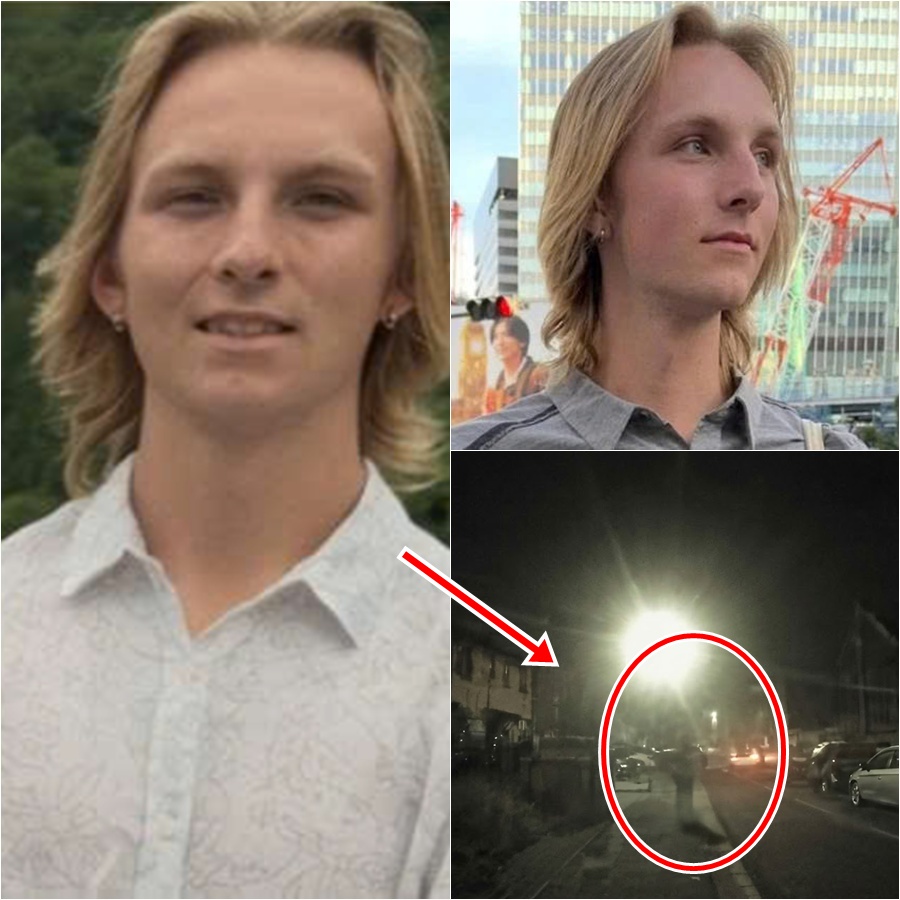
KYOTO, JAPAN – The investigation into the death of James “Weston” Higginbotham, a 20-year-old Auburn University student, has taken an unsettling new turn. Just hours after the young man’s body was discovered on a steep mountainside in the Yamashina outskirts of Kyoto, a local witness has come forward. Her testimony not only shatters the official timeline established by police but also opens a chilling Pandora’s box of questions regarding what truly transpired during that fateful storm on the night of May 29.
As digital investigators from the Kyoto Prefectural Police begin parsing through the final electronic breadcrumbs, the line between a tragic hiking accident and a dark, premeditated scenario is becoming terrifyingly blurred.
Part I: The Storm at Yamashina and the Collapse of a “Perfect Timeline”
Until this new witness emerged, the police file on Weston Higginbotham’s final hours seemed destined to close on a straightforward script: an impulsive young man, angry after a family dispute, making a fatal decision in extreme weather.
According to initial reports, Weston—a brilliant Biosystems and Environmental Engineering major—had engaged in a heated argument with his mother at their central Kyoto hotel. The trigger was her heavy reliance on artificial intelligence (ChatGPT) to plan and navigate the family’s vacation. For Weston, a deeply sensitive thinker harbors profound skepticism toward the rise of technology, this was no minor disagreement; it was an ideological breaking point.
To clear his head, Weston boarded a train alone toward the rural outskirts of Yamashina, an area known for its pristine yet treacherous mountain trails. The final piece of concrete evidence held by authorities was a closed-circuit television (CCTV) frame captured at approximately 8:15 PM on May 29. The image showed the tall, slender student walking alone toward the trailhead just as a violent tropical storm system began battering the region, unleashing torrential downpours onto the forested mountains.
However, that “rock-solid timeline” has just been shattered.
A female resident living near the base of the Yamashina trail noticed the missing person flyers plastered around her neighborhood and contacted authorities. She distinctly remembers seeing a young foreign man matching Weston’s description minutes after the timestamp of the last CCTV footage. Crucially, he was already further up the dark path than police had previously assumed.
Part II: The Mysterious Object in the Dark – A True-Crime Frenzy
What caught the attention of investigators and online sleuths alike was not just Weston’s location, but his highly unusual behavior. The witness described the young man bent over, his entire attention transfixed by a mysterious object cradled in his hand.
“He stood silently in the pouring rain, appearing to deeply analyze or search for something on that object,” the witness recounted through local media.
Initially, the most logical assumption was that Weston was checking his smartphone for GPS mapping. However, the witness debunked this with a chilling detail: There was absolutely no blue light or typical smartphone glow illuminating the student’s face. In the pitch-black forest with no streetlights, the absence of a screen glow meant Weston was holding an entirely analog object, or was deliberately concealing its light.
Almost immediately, this revelation ignited a massive wave of speculation on Reddit’s r/TrueCrimeDiscussion, drawing thousands of comments per hour. Digital detectives quickly split into two primary camps:
1. The “Biological Tracker” Theory
As a progressive biosystems student and avid nature lover, Weston was known to carry a heavy textbook on local butterfly species and ecosystems. Many surmise he might have been utilizing an analog measurement tool (such as a mechanical compass or chemical pH paper) or tracking a specific bioluminescent environmental marker activated by the storm.
2. The “Dead Drop” Theory
More cynical internet sleuths lean toward a darker narrative: Weston’s hike was not random. They theorize he ventured onto the mountain under specific instructions to retrieve a hidden item—a “dead drop” left behind by someone else, explaining why he braved a violent tropical storm to plunge into the deep woods.
Part III: The Final Message and the “Trembling” of Those Left Behind
While the witness testimony re-mapped Weston’s physical movements, his final digital footprint is dealing a heavy psychological blow to those following the case.
Sources close to the digital investigation have leaked a bombshell: A final text message was transmitted from Weston’s device mere moments before his location services were permanently deactivated and his phone went completely dark.
Though the verbatim text remains strictly under seal by the Kyoto Prefectural Police, those familiar with the communication reveal that the content is deeply unsettling. A close family contact—believed to be the direct recipient—was reportedly left “trembling” with visceral shock and anguish upon reading it.
The phrase “making them tremble” has caused a massive rift across Discord servers and X (formerly Twitter), dividing theorists into two major schools of thought:
Camp 1: Coercion and Threat (The Coercion Theory)
Proponents of foul play argue that the text was a frantic, encrypted distress signal. They believe Weston realized he was not alone on the mountain, or had suddenly stumbled upon a terrifying reality that threatened his life. The sheer helplessness and terror conveyed in his words explain why the recipient was left visibly shaken.
Camp 2: An Existential Manifesto (The Existential Farewell)
Conversely, behavioral analysts lean toward a profound psychological crisis. Weston was a philosophically minded individual who frequently expressed existential dread regarding a tech-driven future where humanity is synthesized and controlled by corporate giants. The text may have been a final manifesto—a cold parting shot at his family’s digital lifestyle—announcing his voluntary and permanent “disconnection” from the global grid.
Part IV: The Neo-Luddite Angle – When Technology Is Rejected in Blood
The combination of the non-glowing object and the ominous final message has breathed new life into the “Radical Neo-Luddite” theory, which was initially dismissed as far-fetched when the case first broke.
Note: Luddite is a term used to describe individuals who oppose new technology out of fear that it destroys human values.
On major tech forums, independent analysts are posing a stark question: Was Weston performing a radical ritual of “digital detox”? If the object in his hand was not a glowing phone, it is highly possible he was using an analog navigation tool, or worse—using a crude object to physically destroy his SIM card and tracking chips before discarding the device.
“If he sent a message that made people tremble, it wasn’t a ‘Going for a walk, see you later’ text,” a prominent true-crime analyst on X noted. “It tastes like an ideological boundary line drawn in blood. He told them exactly what he was doing, and the cold reality of it suffocated the recipient.”
Part V: Awaiting Answers from the Yamashina Soil
Faced with immense pressure from international media and online sleuths, the Kyoto Prefectural Police remain extremely guarded. In their latest brief press release, authorities declined to comment on the leaked contents of the text message, emphasizing that any conclusions are premature pending the official autopsy results from the medical examiner.
Nevertheless, one thing is certain: the narrative of a young man simply wandering into the woods to blow off steam after a petty argument with his mother has completely collapsed under the weight of these disclosures. A witness placing him further up the mountain engaging in highly specific, bizarre behavior, alongside a final communication laced with overtones of mortality, suggests the Yamashina wilderness holds a secret far deeper than a simple slip-and-fall accident.
Volunteer search teams have now wrapped up their operations. The Higginbotham family faces the darkest days of their lives in Japan’s ancient capital as they arrange to repatriate their son’s body to Alabama.
The digital world will continue to argue, and AI algorithms will keep running, but the true answer to why a brilliant biological mind walked into the eye of that midnight storm may forever rest within the message that left the world trembling. The upcoming autopsy will provide the physical answers to how Weston died—but to decode the soul and motive behind this tragedy, one must continue to stare into the shadows of Mount Yamashina.