MUSCATINE, IOWA – As police caution tape is gradually removed from the three bloody crime scenes across Muscatine, Iowa, the most agonizing question still hangs heavily in the air: What could turn a husband and father into a cold-blooded killer, driving him to systematically wipe out six of his immediate family members before taking his own life?
As the Iowa Division of Criminal Investigation (DCI), in coordination with local law enforcement, dives deep into recovering digital data, reviewing financial records, and interviewing associates, a dark portrait of Ryan Willis McFarland’s total collapse has begun to emerge. The tragedy on June 1 was not a random, impulsive outburst. Rather, it was the catastrophic climax of a compounding crisis fueled by the ghosts of a criminal past, mounting debt, and the twisted psychology of a textbook “family annihilator.”
1. The “Ghost” of a Criminal Past and Social Isolation
To understand the motive behind Ryan McFarland’s brutal actions, forensic psychologists and investigators have had to re-examine the chronicle of his life. McFarland was not a law-abiding citizen who suddenly lost his way; he possessed a history of antisocial behavior spanning more than three decades. From prison sentences for armed robbery in the 1990s to a “Child Endangerment Resulting in Death” conviction in 2011, McFarland harbored a deeply ingrained resentment toward the legal system and society.
Experts note that having his day-care license permanently revoked and being branded as “the man responsible for an infant’s death” in 2011 inflicted a profound psychological wound on McFarland’s ego. Though he escaped a lengthy prison sentence at the time due to legal technicalities, he was forced to live under the stigma and cold shoulder of a segment of the community.
This isolation intensified following his 2019 conviction for commercial fraud, when he was caught rolling back used car odometers to deceive customers. McFarland gradually fell into a state of profound isolation, cutting off almost all external social ties and interacting strictly within his immediate family. When a man with latent violent tendencies is severed from the outside world, his home can inadvertently become a psychological pressure cooker, where frustrations and bitterness simmer without release day after day.
2. Financial Crisis: The Ultimate Trigger
If his criminal past was the gunpowder, the financial crisis of 2025–2026 was the detonator that triggered McFarland’s fatal frenzy. According to court documents and bank records recently recovered by police, the McFarland family was standing on the precipice of total economic collapse.
After his used car operation was dismantled in 2019, McFarland was unable to secure stable, official employment due to his extensive criminal record. The financial burden of a large household fell squarely on the shoulders of his wife, Mrs. Lesa McFarland, supplemented by the sporadic income from the freelance labor of their adult children.
Bank records show that by early 2026, McFarland had defaulted on his mortgage payments. The family home in the 200 block of Park Avenue had received a foreclosure notice from the lender. The deadline to vacate the property or settle the massive debt was set for June 2026—the exact month the tragedy took place.
More notably, the business property in the 800 block of Grandview Avenue (where one of the victims’ bodies was found) was also entangled in tax liens and commercial lease disputes. Police Chief Anthony Kies stated: “The suspect was facing a comprehensive financial ruin. He was not only losing his home and his pride, but he was also entirely incapable of providing for his young children as bills continued to pile up.”
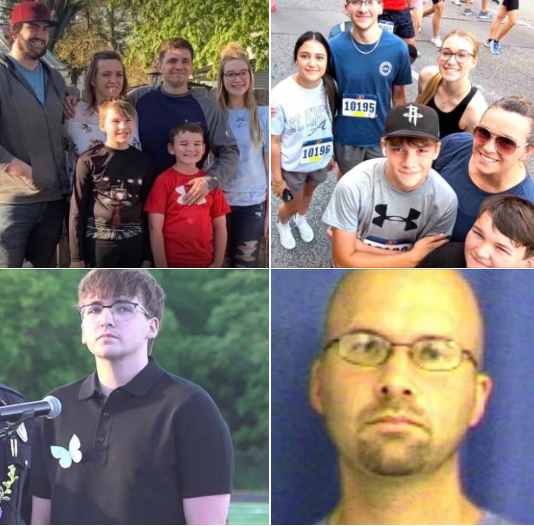
3. The “Family Annihilator” Syndrome and Toxic Possessiveness
Why, when faced with financial ruin, does a father choose to murder his wife and children instead of seeking aid from social organizations? The answer lies in a dark corner of criminology known as the “Family Annihilator.”
Criminal psychologists analyze that individuals like Ryan McFarland often hold toxic, patriarchal views, perceiving family members as possessions or mere extensions of themselves. They define their self-worth through their ability to control and dominate the household. When that control is threatened by economic collapse, their entire worldview shatters.
In McFarland’s distorted psyche, he refused to face the humiliation of eviction, and he could not bear the thought of his children seeing him as a complete failure—or the risk of returning to prison if other desperate acts were uncovered. Instead of enduring that “shame,” he granted himself the authority to decide the life and death of his entire family.
McFarland viewed the massacre as a selfish form of “deliverance.” He believed that if he ceased to exist, his family should not remain to suffer or be gossiped about by society. This explains the systematic and cold-blooded nature of the crime: he traveled across three separate locations, hunting down each person methodically, from his wife of many years to his youngest 13-year-old school-aged son.
4. Internal Strife Simmering Before the Shooting
Another factor investigators are heavily focusing on is the internal family conflicts leading up to June 1. Text messages recovered from the phones of Mrs. Lesa McFarland and her adult sons reveal that the atmosphere in the Park Avenue home had become incredibly strained in the preceding weeks.
Recognizing her husband’s downward spiral and the looming financial danger, Mrs. Lesa was reportedly considering divorce or separation to protect the younger children. The family’s adult sons, including Dakota Whitlow (32) and Austin Harris (29), had repeatedly stepped in to shield their mother and younger siblings from McFarland’s explosive, destructive rages whenever he was intoxicated or desperate.
On the night before the massacre, a fierce argument reportedly broke out regarding the bank’s final foreclosure ultimatum. The resistance from the older children, who stood by their mother and refused to continue giving McFarland money to cover his personal debts, became the “last straw.” For an arrogant yet incompetent man like McFarland, the judgment and rejection from his children was the ultimate insult, fueling a vengeful hatred and activating a horrific slaughter plan he had quietly prepared.
5. Weapon Acquisition and Premeditation
Police have uncovered evidence showing that Ryan McFarland planned this incident at least several days in advance, rather than acting on a momentary impulse. Despite being a convicted felon barred from legally owning firearms under Iowa law, McFarland bypassed the system by purchasing the murder weapon through the black market or a private transaction that required no background check.
The fact that he hoarded a large amount of ammunition and mapped out the daily schedules of each family member to strike at midday—when his victims were either at home or their workplaces—demonstrates a chilling, calculated design. He took four lives at the family home, then moved to two other locations to “erase” his remaining children, ensuring no one could escape his psychotic judgment. The sole survivor, Jonathan McFarland, was left off the casualty list only due to an accidental, last-minute schedule change that the killer did not anticipate.
6. A Belated Warning on Mental Health and Domestic Violence
The tragedy in Muscatine, Iowa, serves as a heartbreaking reminder of how domestic instability, when left undetected and unaddressed, can lead to horrific consequences. It leaves behind a costly lesson regarding the monitoring of high-risk individuals within the community.
Several neighbors living around the Park Avenue area later shared with the media that they occasionally heard shouting coming from the McFarland home, but everyone assumed it was “private family business” and hesitated to intervene. The silence of the community, the lack of robust social safety nets to assist in emergency financial crises, and especially the loophole allowing individuals with violent pasts to obtain firearms, inadvertently nourished the “monster” inside Ryan McFarland until it consumed an entire family.
Currently, the investigation by the Iowa Department of Justice remains ongoing to deliver a final conclusion. Nevertheless, the core cause is already clear: it was a catastrophic convergence of poverty, debt, social desperation, and a selfish, extreme criminal mindset that stripped a father of his humanity.