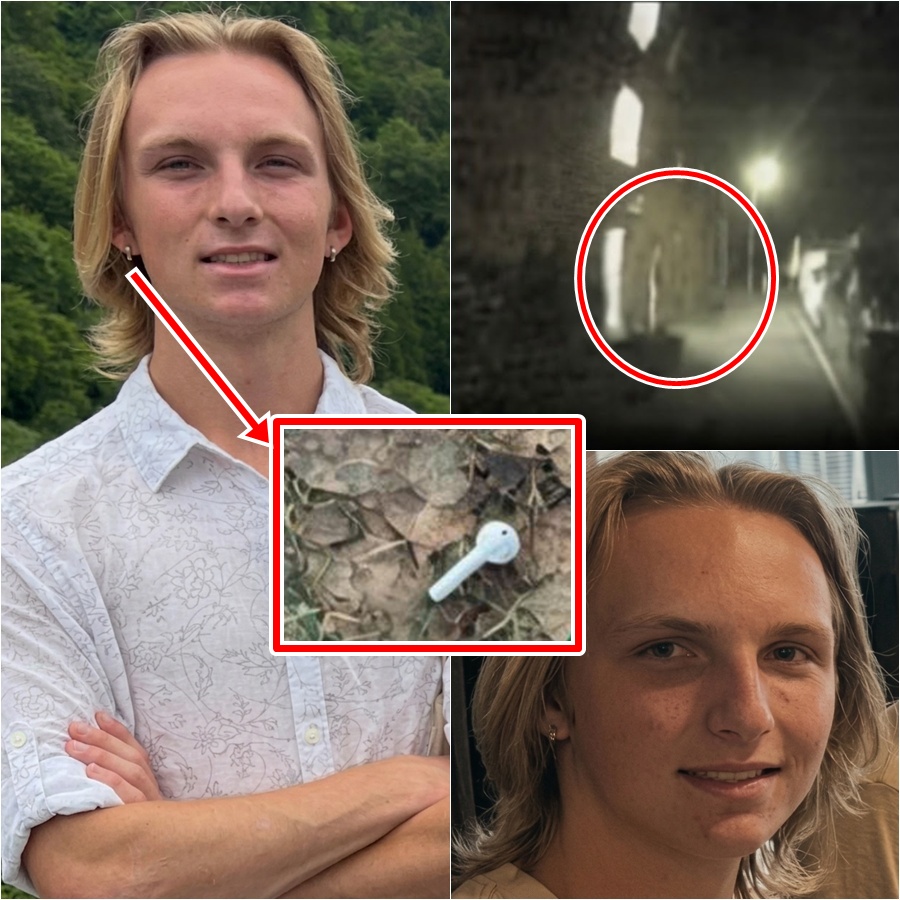
KYOTO, JAPAN – The investigation into the tragic death of James “Weston” Higginbotham—the 20-year-old Auburn University student from Alabama—has taken a dramatic and dark turn. Shifting away from the initial theory of a routine hiking accident caused by severe weather, international investigators and local police are now confronted with a chilling question: What actually happened on that remote concrete footbridge in the Yamashina district?
The epicenter of the investigation has suddenly focused on an item the victim never took off: his signature white wireless headphones. This seemingly minor piece of personal trivia has now become the explosive center of gravity for the entire case, transforming a desolate mountainside into a potential crime scene marked by signs of a nighttime struggle amidst a raging storm.
Part I: The Silent Accessory and a Lifelong Habit
To understand why these headphones have become the linchpin of the investigation, one must look at Weston Higginbotham through the eyes of those who knew him best. Back home in Alabama, Weston was not only recognized as a brilliant biosystems engineering major but also as a deeply introverted young man who often sought a barrier from the noise of the modern world.
A close childhood friend of Weston, who spoke on the condition of anonymity, shared a critical detail with independent true-crime researchers:
“Weston lived in his own world, and those white headphones were essentially his barrier against the outside world. He wore them nearly 24/7—while studying, while walking, even when he was just sitting around the house. He frequently listened to ambient nature sounds, acoustic music, or environmental podcasts to focus.”
The friend emphasized that the idea of Weston voluntarily taking his headphones off while hiking up a dark, remote trail in the middle of a severe tropical storm makes absolutely no sense. For Weston, a howling storm or a chaotic environment was precisely when he would rely on his “barrier” the most. Their absence from his body when it was recovered was the first definitive sign that something went terribly wrong.
Part II: The Scene at the Yamashina Concrete Footbridge
The trajectory of the case drastically altered when a local resident walking near a mountain stream in Yamashina—located just past the last area where Weston was captured on CCTV—spotted a foreign object. It was a single, white wireless earbud resting silently on the edge of a small concrete footbridge.
Kyoto Prefectural Police immediately cordoned off the area and pivoted their investigative approach, heavily interrogating Weston’s inner circle about his headphone habits.
Theories from Online Sleuths
On Reddit’s r/TrueCrimeDiscussion and various Discord servers tracking the case, the Yamashina bridge is now being treated by amateur detectives as a potential “Point of Struggle.”
The digital community argues a tight case:
-
Secure Design: The specific model Weston owned was a secure, tight-fitting wireless brand. Even in the high winds of a severe typhoon, it would not simply fall off during a routine hike.
-
The Violent Disruption Scenario: A heavily circulated post on X (formerly Twitter) analyzed: “If a guy who literally never takes his headphones off drops one on a bridge, it means one of two things: Either he was startled so badly by an unexpected force that it knocked the earbud out, or someone physically grabbed him. The fact that only one was found implies a sudden, violent disruption.”
The discovery of only one earbud strongly reinforces the theory of an abrupt, violent interruption. It does not mirror the actions of someone calmly removing their gear to pack it away, but rather the aftermath of a struggle cut short.
Part III: What Lurks Past the Bridge – Physical Anomalies
While the dropped earbud on the bridge marks the beginning of the timeline, what was allegedly discovered just yards away has sent shivers through the online community. Although official Japanese authorities have kept a tight lid on forensic details, leaked reports from volunteer search networks suggest “physical anomalies” were logged in the immediate vicinity.
+-----------------------------------------------------------------------+
|                 PROPOSED CRIME SCENE MAP (BASED ON LEAKS)             |
+-----------------------------------------------------------------------+
| [Last CCTV Station] ---> [Concrete Bridge] -------------> [Mountain]  |
|                          (1 Earbud Found)        |                    |
|                                                  v                    |
|                                        [Area of Anomalies]            |
|                                        - Displaced/broken foliage     |
|                                        - Inconsistent footprints      |
|                                        - Secondary dropped items      |
+-----------------------------------------------------------------------+
These anomalies include heavily displaced foliage inconsistent with natural storm damage, footprints with treading and sizes that do not match Weston’s hiking boots, and a few secondary personal items scattered nearby.
The Secret Rendezvous or Target Foul Play
The emergence of these physical clues has reignited two major theories previously dismissed: a Secret Rendezvous and Calculated Foul Play.
If Weston was lured to the Yamashina district under false pretenses, or followed from the train station, the isolated bridge provided the ultimate, low-visibility environment for an ambush. The severe typhoon weather, which brought torrential downpours at the time, would have entirely muffled any cries for help. Furthermore, the massive rainfall would act as a natural cleanser, washing away crucial DNA evidence and making it the perfect cover for a targeted crime.
Part IV: A Grim Convergence of Technology
One of the most heartbreaking and ironic dimensions of this tragedy is the conflict between the victim’s life philosophy and how his final moments are being reconstructed. Weston, despite his brilliance in engineering, explicitly despised the encroachment of artificial intelligence and digital over-saturation—a stance that reportedly prompted a “dumb argument” with his mother just before his disappearance.
Yet, his final footsteps are now being meticulously mapped entirely through the “digital ghosts” of the technology he left behind:
-
The Life360 App: Recording intermittent location pings.
-
Disabled GPS: Was it a deliberate choice or a forced action?
-
A Cryptic Text: A brief, “trembling” message sent right before his phone went completely dark.
-
Headphone Bluetooth Data: The core physical-digital link.
Kyoto Prefectural Police have reportedly requested data logs from the headphone manufacturer to pinpoint the exact millisecond the Bluetooth connection to Weston’s phone was severed.
Digital Forensic Scenarios:
Scenario 1: The connection dropped at the exact second the phone was powered off. This would prove an instantaneous physical and digital blackout (e.g., the devices were simultaneously destroyed, submerged, or crushed).
Scenario 2: The headphones remained active after the phone went dark. This implies a third party may have been handling, separating, or manipulating Weston’s devices independently.
Part V: A Deafening Silence from Official Channels
Currently, the Higginbotham family is cooperating closely with the FBI and Japanese officials to expedite the return of Weston’s remains to the United States. However, the silence coming from official investigative channels in Kyoto remains deafening. No statements closing the case have been issued.
The upcoming autopsy results and the comprehensive forensic analysis of the bridge site will ultimately decide the verdict. Was Weston Higginbotham a tragic victim of Mother Nature’s fury, or was he the target of a calculated human predator? Until then, the lone white headphone on a dark Japanese bridge remains a terrifying symbol of a young life abruptly cut short.