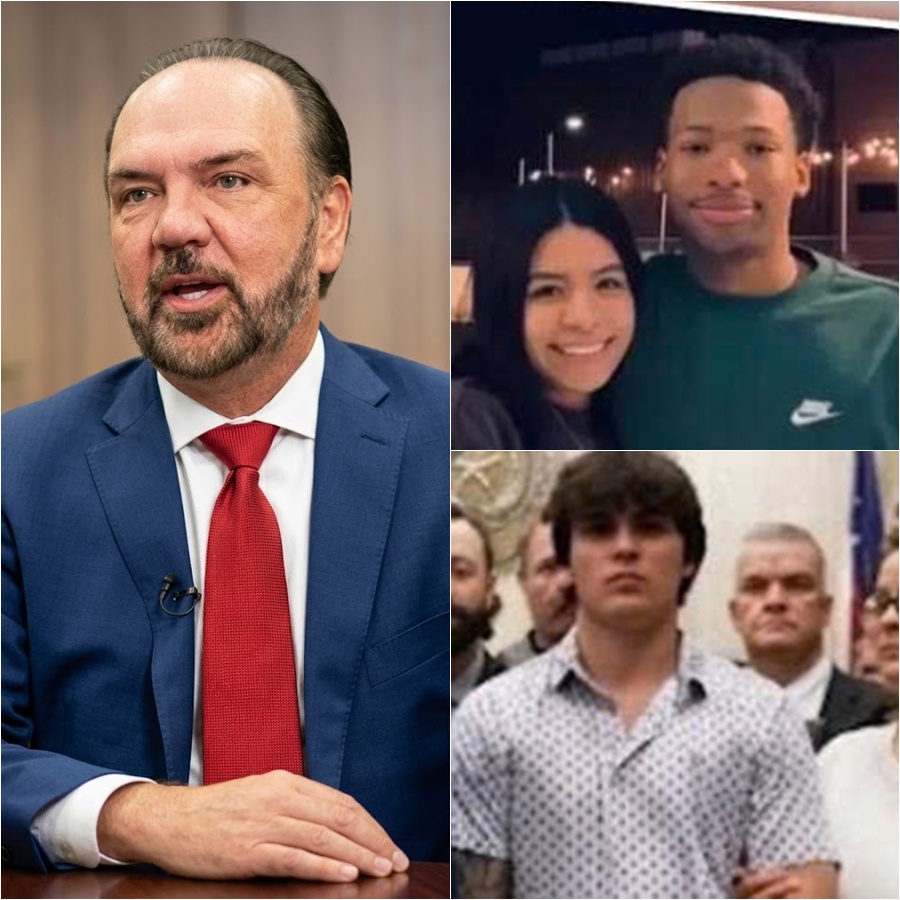
Introduction: A Fateful Sentence and an Onslaught of Online Rage
On a late afternoon in April 2025, a horrific tragedy unfolded inside a team tent during a high school track meet in Frisco—a wealthy and rapidly growing suburb of the Dallas-Fort Worth metroplex. Austin Metcalf, a 17-year-old rising high school football star, collapsed after sustaining a fatal stab wound to the chest. The individual wielding the weapon was Karmelo Anthony, a Black teenager who was 18 at the time.
More than a year later, in early June 2026, the high-profile first-degree murder trial officially concluded at the Collin County Courthouse in McKinney, Texas. Anthony, now 19, was sentenced to 35 years in state prison. The jury took less than three hours to completely reject the defense’s claims of self-defense.
However, instead of bringing closure to the victim’s family and the community, the verdict ignited a fierce “cultural civil war” across social media platforms like X (formerly Twitter), Reddit, and TikTok. The epicenter of the public fury lies not just in the length of the sentence, but in a highly controversial decision by the presiding judge: strictly banning all broadcasting cameras from the courtroom during the trial.
Amidst a firestorm of public criticism accusing the court of suppressing transparency and masking structural racial bias, the judge finally broke silence after the gag order was lifted. Delivering a blunt, unapologetic response to public critics, the judge’s message was brief:
“I sleep well at night.”
Part I: Banning the Cameras — Protecting Witnesses or Covering Up Injustice?
The judge’s decision to black out all live broadcasting cameras from the McKinney courthouse drew heavy criticism from media commentators across both sides of the political spectrum. In an era where modern judicial systems increasingly lean toward transparency via live-streaming high-profile cases, this media blackout was widely viewed as a step backward.
The Perspective of the Court and the Prosecution
According to judicial sources close to the case, the decision to ban cameras was not an act of judicial arrogance, but a calculated preemptive measure. The court’s primary objective was to prevent the eight-day trial from devolving into a lawless “media circus.”
Furthermore, the majority of the eyewitnesses present at the scene of the stabbing were high school students and minors. The court argued that broadcasting their faces and identities on national television would turn them into prime targets for cyberbullying, defamation, and severe online harassment (doxxing).
Collin County District Attorney Greg Willis strongly backed the court’s stance. Willis revealed a shocking detail: throughout the investigation and trial, investigators had to relentlessly combat massive pressure from internet influencers.
“We discovered that outside entities were intentionally fabricating evidence—including manipulated photos and deepfake videos using artificial intelligence—with the sole purpose of manipulating public perception and distorting the facts of the case,” Willis stated.
Outrage from the Online Community
In stark contrast to the procedural explanations provided by authorities, online communities on X and Reddit offered a completely different interpretation. For supporters of Karmelo Anthony, turning off the cameras was a deliberate move to conceal a painful systemic reality: the racial composition of the jury.
Collin County has a Black population of over 12%. However, according to courtroom sources, the panel deciding Anthony’s fate was an all-White or non-Black jury.
One viral post on X with over two million views exposed this stark reality:
“An all-White jury in a county that is over 12% Black, and they turn off the cameras? They didn’t want the world to see how Texas justice operates.”
Critics argued that without the oversight of television cameras, the public could not evaluate whether the jurors were influenced by implicit bias when deciding the fate of a Black teenager.
Part II: Three Hours of Deliberation and the Fine Line Between ‘Self-Defense’ and ‘Murder’
To understand why this case has deeply polarized the public, one must look back at the arguments presented in court, where two entirely conflicting narratives surrounding Austin Metcalf’s death collided.
The Defense’s Argument: “A Split-Second of Fear and Chaos”
In court, defense attorneys painted a picture of a teenager backed into a corner. They argued that Anthony acted in a “split-second of fear and chaos.”
On the day of the incident, Anthony was surrounded by a group of physically imposing football players who significantly outmatched him within the cramped confines of the team tent. The defense maintained that Anthony felt his life and safety were under imminent threat, and drawing the knife was an involuntary survival reflex triggered by the overwhelming pressure of the white athletes. They urged the jury to mitigate the charge to “sudden passion”—a state of mind provoked by intense emotion that robs an individual of ordinary self-control.
The Prosecution’s “Smoking Gun” Evidence
However, the defense’s script of an “underdog victim” completely collapsed when prosecutors presented their digital evidence. Collin County First Assistant District Attorney Bill Wirskye personally introduced surveillance and police bodycam footage to the court.
The sharp footage revealed a completely different truth: Karmelo Anthony was the one who aggressively initiated the verbal dispute and advanced toward the victim. The confrontation peaked when Anthony pulled out a concealed 3.5-inch pocket knife and plunged it into Austin Metcalf’s chest, at a moment when physical contact between the two had barely escalated beyond minor shoving.
“The law is very clear,” Wirskye told reporters firmly after the trial. “You do not get to provoke an encounter, and then when someone touches you, use deadly force. That is not self-defense. That is murder.”
The decisive nature of the video evidence led the jury to reach a verdict incredibly fast. After less than three hours of deliberation—a record short time for a first-degree murder trial—they unanimously declared: Karmelo Anthony is guilty of murder.
Part III: Racial Slur on a Podcast Ignites a New Wave of Hatred
Just when it seemed the court’s verdict would conclude the case, a shocking turn of events completely overturned the prosecutors’ efforts to project an image of an objective, race-neutral trial. It came during an appearance by Jeff Metcalf, the victim’s father, on a digital talk show.
A Scandalous Appearance on JinxedSip
Throughout the trial, the Metcalf family and prosecutors adamantly maintained to the media that this tragedy was strictly about “right and wrong,” about a perpetrator and an innocent victim, and had nothing to do with race.
However, those assertions went up in smoke when Jeff Metcalf appeared on JinxedSip, a prominent podcast hosted by conservative commentator Sarah Fields.
Sitting in front of the camera, the victim’s father made no effort to hide his sense of triumph following the 35-year sentence handed to his son’s killer. But instead of expressing grief or grace, Metcalf unprompted delivered an overtly anti-Black racist slur aimed directly at Anthony. With a wide grin on his face, he said:
“Let me make something racist up so y’all can go viral. I got a new name for ‘Melo, OK?… How about Watermelon Felon? How’s that one strike ya?”
(Context: “Watermelon” is a trope with deep-seated racist historical roots in the United States, used to dehumanize and mock Black people since the Jim Crow era).
Metcalf did not stop there; he went on to attack the defendant’s family, calling Anthony’s parents “grifters” and “cowards,” and labeling Anthony’s mother a “drunk b*tch.”
Fuel for the Defense’s Supporters
The clip from the podcast spread like wildfire across TikTok and Reddit’s true-crime discussion boards (r/TrueCrime). For Anthony’s supporters, this video was the “smoking gun” proving that the social environment surrounding the case was heavily saturated with deep-seated racial prejudice.
A prominent civil rights advocate wrote on Discord:
“They spent a year telling us race had nothing to do with this, and then he goes on a podcast and drops Jim Crow-era slurs with a smile. The court protected this family while treating a teenager like a monster.”
Part IV: Legal Warfare and Future Outlook
Despite the erupting toxicity across public forums, Collin County officials stand firmly behind their work, maintaining that they executed their duties strictly according to the law. The 35-year sentence is now active. Under Texas law for murder convictions, an inmate is not eligible for parole until serving at least half of their term—meaning Anthony must spend at least 17.5 years behind bars.
However, the defense team has no intention of backing down. David Coale, a prominent Dallas-based appellate attorney, confirmed that Anthony’s defense team has already officially filed a notice of appeal with a higher court.
According to legal experts, the upcoming appellate strategy will focus aggressively on the jury selection process (voir dire). The defense will argue that the state unconstitutionally used peremptory strikes to systematically eliminate Black candidates from the panel, creating a racially disproportionate jury.
Conclusion: Justice Under a Microscope
Karmelo Anthony has begun his first days of a lengthy sentence at a Texas Department of Criminal Justice (TDCJ) facility. At 19 years old—the prime of a young man’s life—Anthony’s next chapters will be defined by concrete walls and barbed wire. In another world, Austin Metcalf remains forever 17, his dreams on the football field permanently cut short.
The tragedy for both families is real, and the pain is undeniable. Yet, the Collin County trial has transcended a typical murder case. It has become a mirror reflecting a deep-seated fracture in modern American society: one side fiercely defends a closed judicial process to shut out public “noise,” while a digitized public remains deeply skeptical, ready to place every verdict under the microscope of racial conflict.
The judge may “sleep well at night,” but for the Frisco community and the nation at large, the long night of racial friction and bitter debate has only just begun.