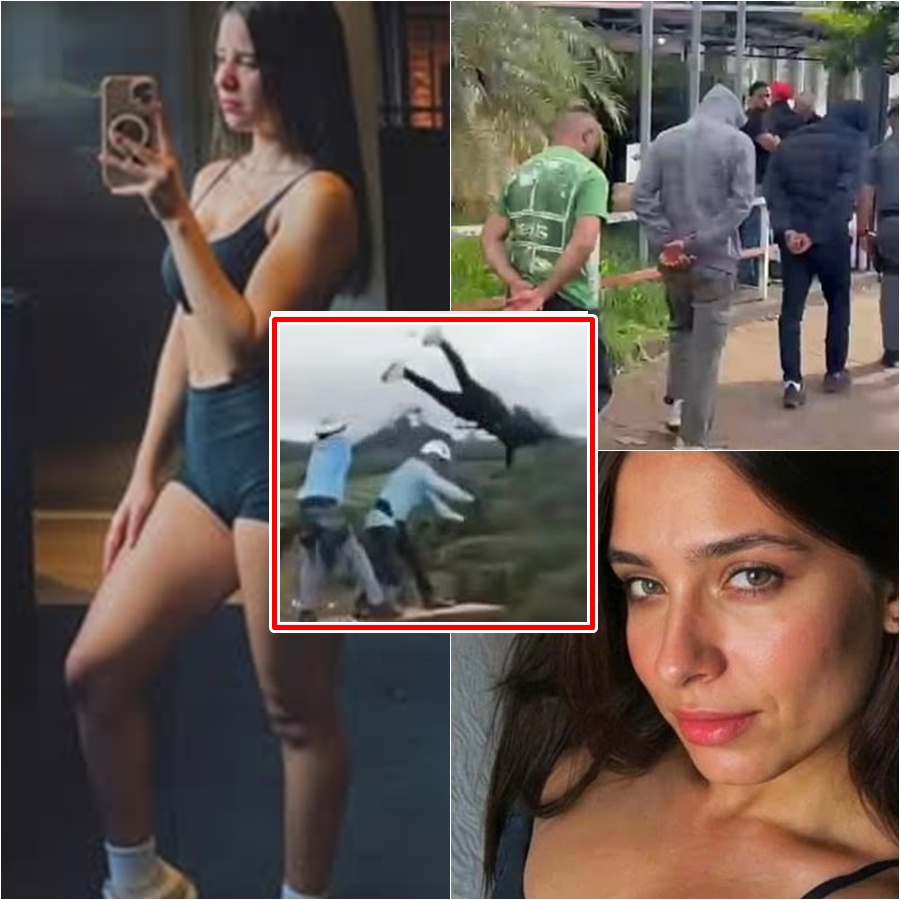
Summary: On June 13, 2026, a horrific accident occurred at the Skeleton Bridge (Ponte do Esqueleto) in São Paulo state, Brazil. Maria Eduarda Rodrigues de Freitas, a 21-year-old recent university graduate, died instantly after a 40-meter (131-foot) freefall. Initial investigations indicate the cause was a shocking, almost unbelievable blunder by the event staff: they completely forgot to attach the safety rope to her harness before launching her off the bridge.
1. The Fateful Moment Captured On Viral Video
A video capturing this horrific moment has spread like wildfire across social media platforms, sparking global outrage and disbelief.
A second-by-second breakdown of the agonizing footage:
-
Initial excitement: The footage opens with a radiant Maria Eduarda geared up in a helmet and harness. Smiling brightly, she holds a small camera, eager to document this milestone adventure with her fiancé.
-
The “Superman” pose: Staff members wearing branded shirts lift her horizontally—mimicking a Superman flying pose—and carry her toward the edge of the bridge. The atmosphere is filled with laughter and casual banter from everyone present.
-
The belated scream: The moment the crew hurls the young woman over the precipice into the open air, the laughter stops instantly, replaced by frantic screams: “A corda, gente, a corda!” (The rope, people, the rope!).
-
The grim reality: On the wooden platform, the main coiled safety line sits untouched, never connected to the harness on her body.
Maria Eduarda plummeted straight down onto the dry, rocky riverbed below from a height of 40 meters without any restraint. Suffusion with severe polytrauma, she was pronounced dead at the scene. Her fiancé, who was standing right next to her to cheer her on, collapsed in total horror as he watched his bride-to-be disappear into death in a split second.
2. Portrait Of The Ill-Fated Graduate And A Hauntingly Ironic Post
Maria Eduarda Rodrigues de Freitas, 21, was from Jandira, a municipality near the city of São Paulo. She had just completed her bachelor’s degree in Physical Education and Sports Management.
A promising future cut short:
-
Passion for sports: Friends and family describe Maria as an outgoing, energetic girl who was passionate about fitness and eager to inspire others to live active lives through her future career in sports management.
-
A fateful premonition: Just days before the trip, Maria posted a photo posing with the organizing company’s banner on social media, adding a playful caption: “Who was the crazy person who let me jump off a bridge?”. Those lighthearted words have now become a painful irony for her family.
Maria chose the rope-jumping experience because she fully trusted the professionalism of the organizers. However, that absolute trust cost her her life.
3. Skeleton Bridge – A High-Risk Hotspot Operating Out Of Control
The accident took place at Ponte do Esqueleto (Skeleton Bridge), spanning the Piracicaba River in the city of Limeira, São Paulo state.
[Background of Skeleton Bridge]
├── Original use: An old, abandoned railway bridge out of service for years.
├── Current state: Rusted, degraded, and overgrown with wild vegetation.
└── Spontaneous function: A magnet for unregulated extreme sports groups.
Despite local authorities repeatedly issuing warnings about the danger and structural instability of the bridge, the location still drew thousands of visitors every weekend. A massive legal loophole created by overlapping jurisdiction (between federal and state authorities) over this abandoned infrastructure allowed opportunistic, informal, or semi-professional extreme sports companies to set up jumping platforms and sell tickets for profit.
4. Six Indicted: When Negligence Becomes A Crime
Immediately after receiving the emergency call, the Brazilian Military Police cordoned off the scene. Six individuals linked to the two organizing groups, Entre Cordas and Ih Voei (comprising 5 men and 1 woman), were detained at the scene.
Key details of the legal proceedings:
| Criteria | Case Details |
| Detained individuals | 6 staff members and managers present at the scene. |
| Current status | 3 primary suspects remain in custody without bail for further investigation. |
| Charges filed | Homicide with “Dolo Eventual” (Manslaughter with implied malice / Reckless indifference to human life). |
| Legal nature | The defendants did not plan to kill, but their failure to perform a core safety check proves they consciously assumed the risk of taking a customer’s life. |
As public outrage escalated, Entre Cordas and Ih Voei immediately deactivated all their information pages and social media accounts to evade accountability. However, prosecutors managed to swiftly seize all transaction records and employee rosters.
5. Professional Analysis: Unforgivable Basic Mistakes
After carefully analyzing the footage, experts from the International Extreme Sports Association pointed out a series of systemic failures by the organizers:
-
No double-check protocol: In standard extreme sports like bungee or rope jumping, it is mandatory for at least two independent technicians to verify the harnesses, carabiners, and ropes before authorizing a jump. Here, this step was entirely ignored.
-
Loose manual handling: Instead of using a fixed anchor system or proper rigging to safely guide the jumper to the edge, the staff manually carried her out. This caused a distraction, making them forget the vital safety line.
-
Unprofessional attitude: The joking and laughing in the final seconds prove that the crew operated with a complacent mindset, disregarding the minimum safety standards of a high-risk industry.
6. Public Fury And Pressure For Total Reform In Extreme Tourism
Maria Eduarda’s death is not just a tragedy for one family; it has ignited a fierce national debate across Brazil regarding the regulation of budget extreme tourism.
Charging low ticket prices between 130 and 180 reais (approximately $25 – $35 USD), these operators cut corners on certified equipment, failed to provide accident insurance for customers, and relied on untrained seasonal labor to maximize profits.
Statement from the City Government of Limeira:
“We will file a lawsuit against the federal management authorities for leaving the Skeleton Bridge abandoned for years without installing proper barriers or completely isolating the site. Furthermore, the city orders an immediate and permanent ban on all spontaneous extreme sports activities in this area starting today.”
The global online community and consumer protection organizations in Brazil are continuously pushing hashtags demanding justice for Maria Eduarda. They are demanding that the National Congress pass stricter legislation, requiring:
-
All companies operating extreme sports to be strictly licensed by the Ministry of Tourism.
-
Mandatory real-time surveillance cameras at jump platforms to securely store safety data.
-
Operators and staff to hold international technical safety and rescue certifications.
7. Conclusion: The Echoes Of A Silenced Smile
The Skeleton Bridge now stands silent and solitary over the Piracicaba River, serving as a heartbreaking monument to human negligence. The tragedy of Maria Eduarda Rodrigues de Freitas is a costly lesson written in blood: extreme sports only bring joy when built on a foundation of absolute discipline.
The image of her radiant, trusting smile right before plunging into the open air will haunt viewers for a long time. It stands as a stark warning to regulators, tour operators, and thrill-seekers alike: never compromise on safety, because the price to pay is sometimes your only life.