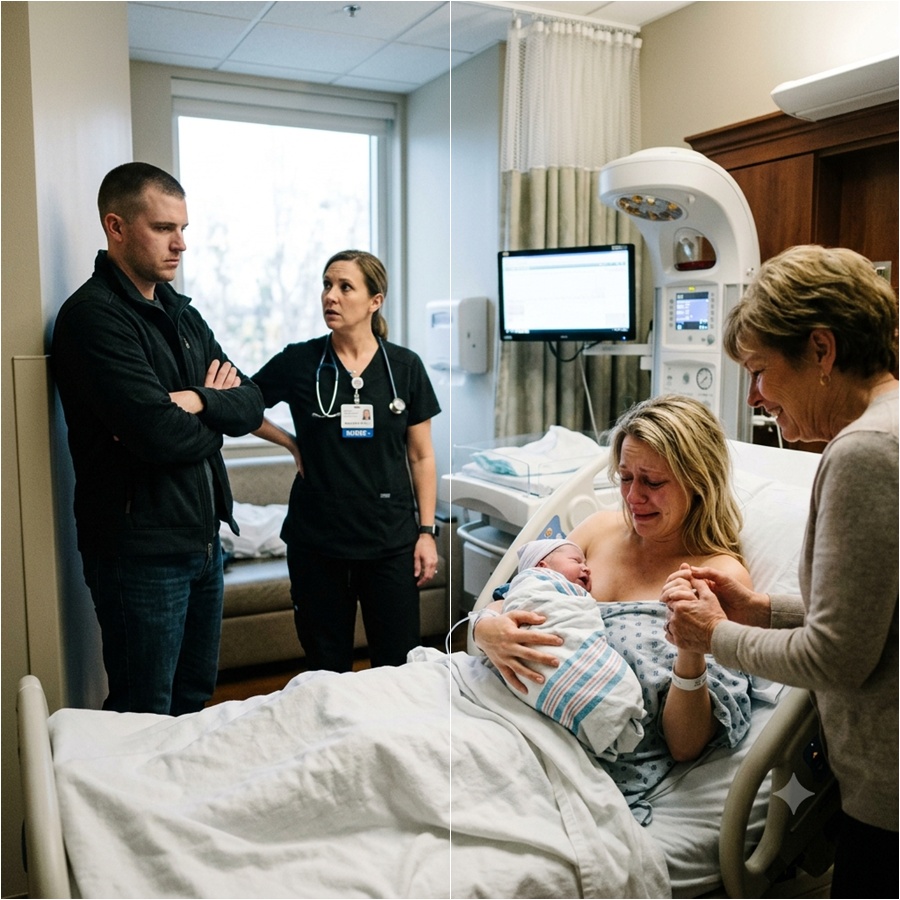
Only three minutes after our little boy entered the world, my husband asked for a paternity test.
He spoke loudly enough that the nurse paused while gently wrapping our newborn in a warm blanket.
His words were also loud enough for my mother to let the paper cup of ice chips slip from her hands. She had been holding it for me through nearly eleven hours of labor.
For one long moment, the delivery room at St. Catherine’s Women’s Hospital in Phoenix became completely quiet.
The only sound left was our baby’s tiny cry as he rested against my chest.
The lights overhead felt painfully bright.
Everything around me was a blur of exhaustion.
My hospital gown clung to my skin, and loose strands of hair stuck to the back of my neck. Every part of me felt drained after hours of labor. I had never imagined just how overwhelming bringing a child into the world could be.
Sixteen long hours had led to this moment.
Our moment.
Our son.
The baby Daniel and I had prepared for together.
We had painted his nursery side by side. We had assembled his crib, folded his tiny clothes, and talked for months about the future.
It was Daniel who had chosen his name while we were standing in the paint aisle of a hardware store.
“Oliver,” he had said with a smile.
“Strong. Honest. A name that will always stand tall.”
Now he wouldn’t even say it.
Instead, he quietly looked at our son and said,
“I don’t believe the baby is mine.”
For a second, I wondered if exhaustion had made me hear him incorrectly.
Pain, sleeplessness, and everything that comes with childbirth can make the world feel unreal.
I tried lifting my head, but my body was trembling too much to stay upright.
“What did you say?” I whispered.
Daniel remained standing near the foot of my bed, wearing the same gray sweater he had arrived in earlier that morning.
His hands stayed in his pockets.
He stared at the baby with an expression that was strangely distant.
More than anything, it was the calmness on his face that frightened me.
“He doesn’t look like me, Emily.”
Before I could answer, my mother, Ruth Carter, stepped forward.
She had spent thirty-four years teaching kindergarten.
She had comforted frightened children, tied countless shoelaces, wiped away tears, and always knew exactly what to say when someone needed kindness.
I had seen her disappointed.
I had seen her upset.
But I had never heard the quiet firmness in her voice as she spoke next.
“Daniel,” she said, “I hope you’ve thought carefully about what you’re saying.”
He didn’t even turn toward her.
“I’m not signing any paperwork until we have a paternity test.”
The nurse, Patricia, whose silver hair was tucked neatly beneath her cap, paused with the baby’s blanket still in her hands.
She looked at me.
Then at Oliver.
Then back at Daniel.
For just a brief moment, something changed in her expression.
It wasn’t simply surprise.
It looked almost like recognition.
I noticed it, but I was too emotionally overwhelmed to understand why.
“Daniel,” I said softly, my voice shaking, “he’s our son.”
He gave a short laugh without any warmth.
“I’m only asking for certainty.”
The words settled over the room like a heavy weight.
I pulled my baby a little closer.
He was warm, tiny, and peacefully resting against me.
A small line appeared between his eyebrows, giving him a serious little expression that almost made him look curious about the unfamiliar world around him.
Then he let out another gentle cry.
That tiny sound reached deeper into my heart than I could ever explain.
At that moment, nothing mattered more than protecting the little life I had just welcomed into the world.
No one spoke for several long seconds.
The room remained silent until Patricia gently carried Oliver to the warmer to complete the routine newborn checks.
As she walked away, she glanced at Daniel again. This time, her expression was impossible to ignore.
She knew something.
After making sure Oliver was healthy, Patricia returned and quietly asked my mother if she could stay with me for a few minutes.
Then she turned to Daniel.
“Sir, would you mind stepping into the hallway with me for just a moment?”
Daniel shrugged and followed her without hesitation.
The door closed behind them.
My mother squeezed my hand.
“Don’t waste your strength thinking about him,” she whispered. “Right now, your son needs you.”
A few minutes later, raised voices drifted in from the hallway.
I couldn’t make out every word, but I clearly heard Patricia say,
“I’ve seen this before.”
Daniel answered sharply, though I couldn’t hear what he said next.
When he finally walked back into the room, his confidence had faded. His face looked pale, and he avoided looking directly at me.
He simply repeated,
“I still want the test.”
I nodded.
“Fine.”
The word surprised everyone, including Daniel.
“If a test is what you need to be a father, then we’ll do it.”
A week later, the results arrived.
There was no uncertainty.
Daniel was Oliver’s biological father.
I expected relief.
Instead, he only became quieter.
Finally, he admitted the truth.
Several months before I became pregnant, one of his coworkers had discovered that he was raising a child who wasn’t biologically his. Since then, Daniel had spent hours reading stories online about broken marriages, hidden secrets, and paternity disputes.
Little by little, fear replaced trust.
He convinced himself that asking for proof was simply being careful.
He never stopped to think about what his accusation would do to me.
He apologized over and over.
He admitted that he had allowed strangers on the internet to shape his thinking instead of trusting the woman he had shared his life with.
But some words leave marks that apologies cannot erase overnight.
For weeks, every time I looked at him, I remembered standing in that delivery room holding our newborn while the happiest moment of my life turned into one of the most painful.
Trust isn’t destroyed because of a laboratory result.
It’s damaged the moment someone chooses suspicion over love.
Daniel spent months trying to earn back what he had lost.
He attended counseling with me.
He became the father Oliver deserved.
He never missed a doctor’s appointment, never complained about late-night feedings, and never again questioned whether Oliver was his son.
Slowly, I saw the man I had married returning.
Not because a DNA report proved anything.
But because his actions finally matched his promises.
Looking back now, I don’t remember the test itself.
I remember a tiny baby lying on my chest.
I remember my mother’s steady hand holding mine.
I remember a nurse who protected my dignity when I was too exhausted to protect it myself.
And I remember learning that trust is never built by demanding proof.
It is built every single day through respect, honesty, and the choice to believe in the people we love.
Oliver is six years old now.
He knows nothing about what happened on the day he was born.
To him, his father is simply the man who teaches him to ride a bicycle, reads bedtime stories, and cheers the loudest at every soccer game.
One day, if Oliver ever asks me what makes a family strong, I won’t tell him it’s a DNA test.
I’ll tell him it’s the decision to show up, to take responsibility, and to choose love—even after making a terrible mistake.