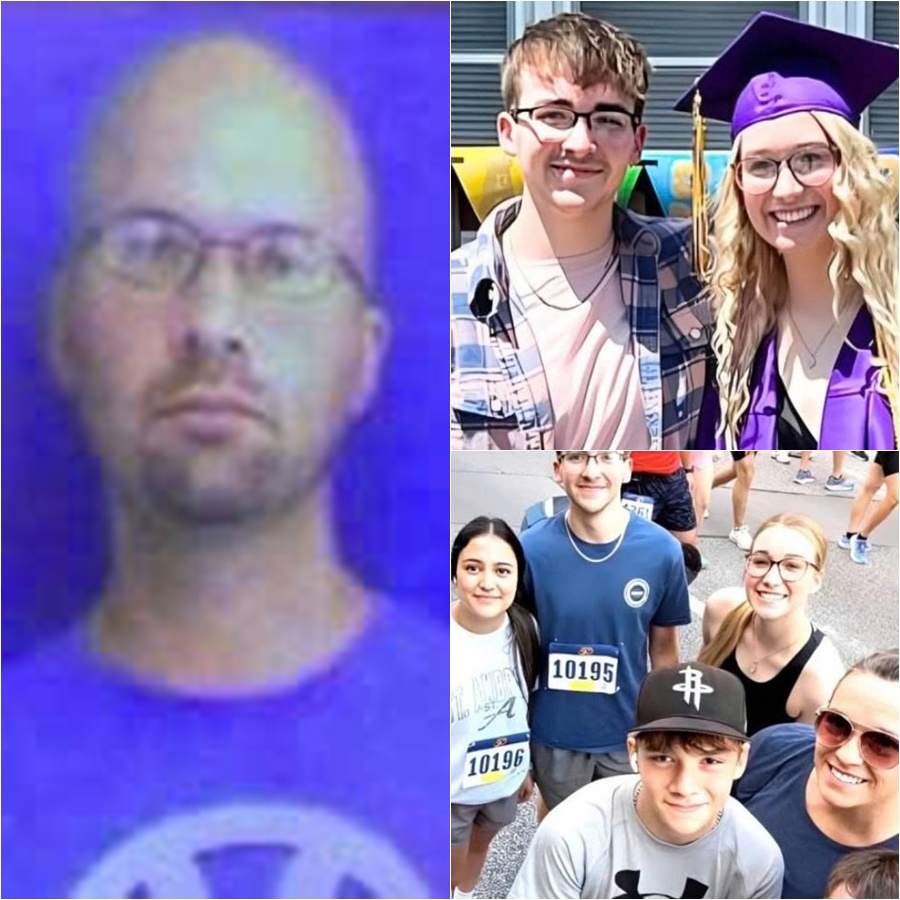
The city of Muscatine, Iowa, is enduring its darkest hours in local history this June 2026. The horrific family massacre perpetrated by 52-year-old Ryan Willis McFarland is not only a tragedy of blood and tears, but also a shocking wake-up call regarding what can only be described as a “programmed crime.” As data buried deep within the killer’s computer and smartphone was recovered, the veil of mystery over his motive and ultimate cruelty was thoroughly stripped away.
1. The Devil’s Overture: When Financial Strain Ignited a “Deadly Journey”
According to an 80-page digital forensics report leaked from the Muscatine County Attorney’s Office, the first anomalies in Ryan McFarland’s cyber activity began surfacing in mid-April 2026. This timeline directly coincided with a breaking point in his personal finances—fueled by lingering debts from a 2016 felony fraud case—combined with an irreparable fracture in his marriage to his 51-year-old wife, Lesa McFarland.
Instead of seeking legitimate legal remedies, financial counseling, or psychological help, McFarland chose to immerse himself in the dark corners of the Internet. Although his browser history had been deleted, digital forensics experts successfully recovered a string of haunting search queries:
-
“How to disappear without a trace?”
-
“Financial pressure and the collapse of a large family.”
-
“The psychology of those who choose a negative escape.”
Investigators’ Assessment:
These were not spontaneous thoughts. This was the “incubation period”—the phase where the twisted notion of wiping out his entire family took root in the mind of a highly narcissistic and controlling individual. McFarland spent hours late at night reading about historic cases of “Family Annihilators,” studying how past perpetrators dealt with law enforcement and how they timed their attacks.
2. A Cold-Blooded May: Systematizing the Crime and Weapon Acquisition
As the calendar turned to May 2026, McFarland’s initial theoretical research and psychological curiosity rapidly shifted into concrete, cold-blooded, and chillingly precise logistical preparation.
Maximum Lethality and Desolate Silence
McFarland’s browser history recorded a series of queries regarding the technical specifications of firearms. He focused heavily on ensuring his victims would be unable to resist or cry out for help:
-
“Which handgun has the maximum stopping power at close range?”
-
“How to reduce the muzzle report of a 9mm round in an enclosed space.”
-
“Fatal shot placement on the human body so a victim cannot scream for help.”*
Mapping Out Death
The sheer ruthlessness of McFarland’s intent peaked when he began organizing the logistics of the massacre. Due to their ongoing estrangement, his family members were living across three separate locations in the city. McFarland used online maps to chart a flawless “hunting route”:
| Target Location | Target Victims | Purpose of Map Searches |
| 210 Park Avenue | Wife (Lesa) and 3 youngest children (Ryle, 20; Mark, 16; Ryan Jr., 13) | Measuring approach routes and travel times during various hours of the day to avoid traffic. |
| Mill Street | Son, Austin Harris (29) | Identifying entry and exit points at his workplace, calculating the escape route after firing. |
| Grandview Avenue Area | Oldest son, Dakota Whitlow (32) | Surveying the surrounding terrain to ensure the victim would have no way to escape. |
This meticulous preparation explains the devastating reality that followed: McFarland systematically stole the lives of his wife and five children across three different crime scenes in a short window of time, leaving no one with enough time to realize the danger and warn the others.
3. Three Days Before the Tragedy: Sidewalk Screams Rehearsed in Cyberspace
Between May 28 and May 31, 2026, McFarland’s computer was running at peak capacity. Search algorithms recorded that he barely slept, constantly opening incognito tabs to browse extreme, dark content.
A discovery that sent shivers down the spines of investigators was the origin of the macabre phrase McFarland bellowed at the intersection of Park Avenue right before drawing his weapon and entering the home: “Don’t worry about money anymore. Everything goes away when you die!”
Even more terrifyingly, exactly 24 hours before the first gunshot, McFarland searched the phrase: “What is the average response time for Muscatine police when receiving a 911 call?” This proves he was completely lucid, fully aware of his criminal actions, and actively racing against law enforcement down to the minute.
4. Profiling the Annihilator: When Narcissism Becomes a Sinking Blade
State criminal psychologists in Iowa spent weeks dissecting McFarland’s online behavior. They noted that his digital footprint reflects the classic psychological degeneration of a “Family Annihilator.”
McFarland possessed a deeply patriarchal and controlling nature, paired with extreme narcissism. He viewed his wife and children not as independent individuals, but as “property” under his ownership. Facing absolute financial bankruptcy and societal failure, his ego could not tolerate watching his family continue a life that he could no longer provide for or control.
In McFarland’s warped psyche, he cast himself as a twisted “savior.” He deluded himself into believing that killing Lesa and the children was “releasing” them from financial burdens and protecting them from the bleak future of a broken home. The core of this crime was not love or mercy, but ultimate selfishness: “If I cannot have them, or control their lives, then no one else will.”
5. Heartbreak for the Survivor and the Official Response
When these digital findings were shared in restricted briefings with relatives, the emotional trauma was torn wide open once more.
Jonathan McFarland—the sole surviving son who miraculously escaped the massacre—was left completely shattered. Already bearing the unimaginable grief of losing his mother and all of his siblings, he now had to face the cruel reality that his father had been quietly plotting the slaughter for weeks. Knowing that his loved ones spent their final days living alongside a monster who spent his nights researching the most efficient ways to kill them serves as a horrific form of psychological torture for Jonathan.
Statement from an Iowa Division of Criminal Investigation (DCI) Representative at a Press Briefing:
“The data recovered from Ryan McFarland’s computer completely refutes any theory of a crime committed out of sudden passion or temporary loss of control. This was a calculated, scheduled mass murder prepared with some of the coldest, most meticulous weapons and logistics research we have ever witnessed. The suspect knew exactly what he was doing, fully understood the consequences, and chose to carry his criminal plot to its final, devastating end.”
6. A Warning from Cyberspace: The Forgotten “Digital Footprints”
The Muscatine, Iowa massacre, viewed through the lens of a computer search history, leaves behind a costly and painful lesson for the digital age. It highlights that modern perpetrators often leave clear “digital footprints” before committing violent acts, yet these signs are easily missed because they remain hidden behind privacy walls or closed laptop screens late at night.
Early Warning Signs (“Red Flags”) to Watch For in Communities:
-
Sudden changes in digital habits (staying up late routinely, constantly clearing browser histories, continuous use of incognito mode).
-
A combination of severe financial crisis and veiled threats about “disappearing” or finding a permanent “release.”
-
Social isolation coupled with an obsession with extreme domestic violence content on the internet.
Domestic violence in the modern era does not manifest solely through physical abuse or shouting matches in the street; it also plays out silently in the internet queries of individuals experiencing severe mental decomposition. If his financial collapse and veiled threats, combined with his shifting tech habits, had been detected and intervened upon earlier, perhaps this tragedy could have been averted.
Conclusion
The digital files on Ryan McFarland have closed, and his computer now sits silently in an evidence locker—a testament to the complete collapse of a human being. While the perpetrator ultimately committed suicide along the riverfront trail to escape justice, the dark tracks he left in cyberspace and his ruthless weapon that afternoon will forever remain a suffocating ache in the hearts of Iowans, serving as a cold reminder of the monsters that can hide behind seemingly harmless search commands.